
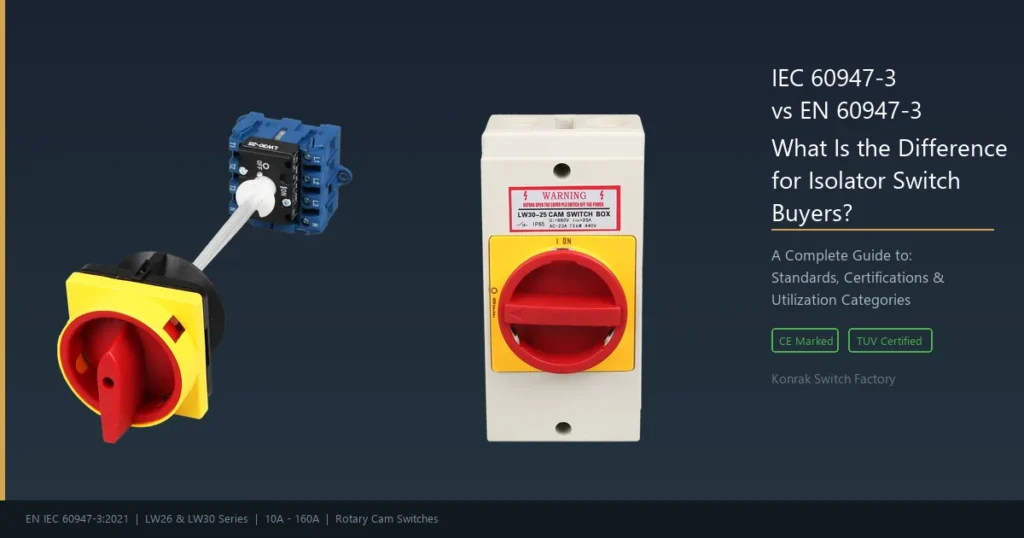
If you are sourcing isolator switches, disconnect switches, or switch disconnectors for panel building, OEM equipment, or industrial installations, you have almost certainly encountered two standard numbers: IEC 60947-3 and EN 60947-3.
They look similar. They are often used interchangeably on product data sheets. But if you are buying for the European market, or sourcing from manufacturers who claim compliance with “the standard,” understanding the precise relationship between these two numbers is essential for making the right purchasing decision.
This guide will clarify:
- What IEC 60947-3 and EN 60947-3 actually are
- Whether there is a real technical difference between them
- How these standards relate to CE marking and TUV certification
- Which utilization categories (AC-21A, AC-23A, etc.) matter for your application
- What a compliant isolator switch specification sheet should look like
What Is IEC 60947-3?
IEC 60947-3 is an international standard published by the International Electrotechnical Commission (IEC), the global body that develops universally accepted standards for electrical, electronic, and related technologies.
The full title of the standard is:
IEC 60947-3: Low-voltage switchgear and controlgear — Part 3: Switches, disconnectors, switch-disconnectors and fuse-combination units
This standard specifies the requirements for switches, disconnectors, switch-disconnectors, and fuse-combination units intended for use in circuits where the rated voltage does not exceed 1,000 V AC (with frequencies up to and including 1,000 Hz) or 1,500 V DC.
It is the most widely referenced standard in the world for isolator switches and disconnect switches. When a manufacturer in China, Turkey, Brazil, or any non-EU country claims their switch “meets international standards,” they are almost always referring to IEC 60947-3.
Key Parameters Defined by IEC 60947-3
| Parameter | Meaning |
|---|---|
| Ui (Rated Insulation Voltage) | The maximum voltage the switch can withstand in terms of insulation |
| Ue (Rated Operational Voltage) | The voltage at which the switch is designed to operate under normal conditions |
| Ith (Rated Thermal Current) | The maximum current the switch can carry continuously without exceeding temperature limits (8-hour rating) |
| Ie (Rated Operational Current) | The current the switch can make or break at the specified voltage, under specified utilization categories |
| Uimp (Rated Impulse Withstand) | The switch’s ability to withstand voltage surges (lightning, switching transients) |
| Icw (Rated Short-Time Withstand) | The maximum short-circuit current the switch can withstand for a specified duration (typically 1 second) |
| Icm (Rated Short-Circuit Making) | The peak short-circuit current the switch can safely close against |
What Is EN 60947-3?
EN 60947-3 is the European version of the same standard. It is published by CENELEC (Comité Européen de Normalisation Électrotechnique), the European Committee for Electrotechnical Standardization.
Here is how it works:
- IEC publishes the international standard (IEC 60947-3)
- CENELEC adopts the IEC standard as a European standard (EN 60947-3)
- During adoption, CENELEC may add European-specific deviations (usually related to national electrical grid characteristics or local regulatory requirements)
- The resulting EN standard becomes harmonized under the EU Low Voltage Directive (2014/35/EU)
Once harmonized, compliance with EN 60947-3 gives a manufacturer the presumption of conformity with the EU Low Voltage Directive — which is a legal requirement for CE marking.
Key point: EN 60947-3 is the standard that carries legal weight within the European Union. If you are importing isolator switches for use in Hungary, Slovakia, Serbia, Romania, Germany, or any EU country, you need products that comply with EN 60947-3 — not just IEC 60947-3.
Is There a Technical Difference Between IEC 60947-3 and EN 60947-3?
In practice, the technical content is nearly identical. CENELEC’s policy for most recent editions of IEC 60947-3 has been to adopt the IEC text word-for-word, without significant European deviations.
However, there are subtle but important differences in how the standards function:
| Aspect | IEC 60947-3 | EN 60947-3 |
|---|---|---|
| Publishing body | IEC (International) | CENELEC (European) |
| Geographic scope | Global reference | European Union + EFTA countries |
| Legal status in EU | Informational only | Harmonized standard under LVD 2014/35/EU |
| CE marking presumption | No | Yes |
| Testing laboratory | Any accredited lab worldwide | Must be EU-recognized (or TUV equivalent) |
| Technical content | Base text | Identical to IEC (latest editions) |
| Common deviations | N/A | Rare; typically related to temperature derating |
Practical takeaway: If a product is tested and certified to EN 60947-3, it automatically satisfies IEC 60947-3. The reverse is not necessarily true — a product tested to IEC 60947-3 at a non-European lab may not automatically qualify for CE marking without additional EU-recognized testing.
How These Standards Relate to CE Marking and TUV Certification
Understanding the certification chain is critical for isolator switch buyers:
CE Marking
CE marking is not a certification — it is a manufacturer’s self-declaration that their product complies with all applicable EU directives. For isolator switches, the relevant directive is the Low Voltage Directive (LVD) 2014/35/EU.
To make a valid CE declaration, a manufacturer must:
- Design the product to meet EN 60947-3 requirements
- Conduct or commission testing (internal or third-party)
- Create a Technical Construction File (TCF)
- Issue an EU Declaration of Conformity
- Apply the CE mark to the product
The problem: CE marking is based on self-declaration. The manufacturer does not need to submit test reports to any government body. This means CE marking alone provides limited assurance of actual compliance.
TUV Certification
TUV certification adds an independent third-party verification layer:
- A TUV-recognized testing laboratory examines the product
- Testing is conducted against EN 60947-3 (or IEC 60947-3) requirements
- The TUV mark on a product means it has passed independent, certified testing
- This provides significantly higher confidence than CE self-declaration alone
| Feature | CE Mark Only | CE + TUV Mark |
|---|---|---|
| Testing | Self-declared (internal or unknown lab) | Independent third-party verified |
| Test report | May or may not be available | Full TUV test report issued |
| Market confidence | Basic compliance | High confidence |
| Audit | No factory audit required | Annual factory audit (for TUV Mark) |
| Best for | Price-sensitive markets | Quality-focused markets (EU, Middle East) |
For panel builders and OEMs: When your end customers require documented proof of compliance — especially in regulated industries like elevators, mining, or energy — a TUV certificate is far more persuasive than a CE declaration. Many specifiers in European projects explicitly require TUV or VDE certification as part of their procurement specifications.
Utilization Categories Explained
One of the most important aspects of IEC/EN 60947-3 is the utilization category system. This defines the types of electrical loads a switch can safely make and break. Choosing the wrong utilization category can lead to premature contact failure, overheating, or even fire hazard.
The Most Common Categories for Isolator Switches
| Category | Load Type | Typical Application |
|---|---|---|
| AC-20A | Switching under no-load conditions (isolating only) | Isolation switches for maintenance |
| AC-21A | Switching resistive loads (including moderate inrush) | Distribution circuits, heating elements, lighting |
| AC-22A | Switching mixed resistive and inductive loads | General purpose switching, transformers |
| AC-23A | Switching motor loads or high inrush currents | Motor isolation, compressors, pumps, fans |
| AC-3 | Squirrel cage motor starting and breaking during running | Direct motor control (motor switches) |
| AC-4 | Squirrel cage motor starting, plugging, inching | Frequent motor reversing, inching operations |
Common mistake: Many buyers only check the rated current (e.g., “32A switch”) without verifying the utilization category. A switch rated 32A under AC-21A may only be rated 15A under AC-23A. If you use an AC-21A rated switch to isolate a motor circuit, the contacts will degrade rapidly under motor inrush currents.
How to Read a Utilization Category on a Specification Sheet
A properly specified isolator switch should show multiple current ratings corresponding to different utilization categories. For example, a 32A switch might be rated:
| Utilization Category | Rated Current (Ie) | Motor Power Equivalent |
|---|---|---|
| AC-21A / AC-22A | 32A | — |
| AC-23A | 30A | 15 kW |
| AC-3 | 22A | 11 kW |
| AC-4 | 11A | 5.5 kW |
Notice how the same physical switch has different current ratings depending on the load type. This is why utilization categories matter — and why a complete specification sheet is essential.
—What a Compliant Isolator Switch Specification Should Look Like
When evaluating an isolator switch supplier, ask for a specification sheet that includes all of the following parameters. Any missing parameter is a red flag:
Complete Specification Checklist
| Parameter | Required? | Why It Matters |
|---|---|---|
| Standard reference | Yes | Must state EN IEC 60947-3:2021 (latest edition) |
| Ui (Rated Insulation Voltage) | Yes | Must be ≥ the system voltage (typically 690V) |
| Ue (Rated Operational Voltage) | Yes | Must match your application voltage |
| Ith (Thermal Current) | Yes | Maximum continuous current |
| Ie per utilization category | Yes | AC-20A, AC-21A, AC-22A, AC-23A minimum |
| Uimp (Impulse Withstand) | Yes | Typically 2.5kV minimum |
| Icw (Short-Time Withstand) | Yes | Must exceed your system’s prospective fault current |
| Icm (Short-Circuit Making) | Yes | Peak withstand capacity |
| Positive opening | Yes | Critical for isolation safety and LOTO |
| IP rating | Recommended | IP65 for wet/dusty environments |
| Electrical endurance (cycles) | Recommended | Indicates contact durability |
| Mechanical endurance (cycles) | Recommended | Indicates mechanism durability |
| Mounting type | Yes | Panel, DIN rail, door interlock options |
Red flag checklist: If a supplier’s data sheet shows only the rated current (e.g., “32A Isolator Switch”) without utilization categories, short-circuit ratings, or standard reference, you cannot verify that the product actually complies with EN 60947-3. A proper compliance specification should show at minimum 10 parameters.
Reference Example: A Fully Compliant Specification
The following table shows what a complete EN IEC 60947-3:2021 compliant specification looks like, using a 32A rated switch as an example:
| Parameter | Specification |
|---|---|
| Standard | EN IEC 60947-3:2021 |
| Ui (Rated Insulation Voltage) | 690V |
| Ue (Rated Operational Voltage) | 440V |
| Ith (Rated Thermal Current) | 32A |
| Ie (AC-21A / AC-22A) | 32A |
| Ie (AC-23A) | 30A / 15 kW |
| Ie (AC-3) | 22A / 11 kW |
| Ie (AC-4) | 11A / 5.5 kW |
| Uimp (Rated Impulse Voltage) | 2.5 kV |
| Icw (Rated Short-Time Withstand) | 480A / 1s |
| Icm (Rated Short-Circuit Making) | 676A |
| Positive Opening | Yes |
| Padlockable | Yes (LOTO compliant) |
| Mounting Options | Panel mount, DIN rail, door interlock |
| IP Rating (with enclosure) | IP65 available |
| Certifications | CE marked, TUV certified |
Example based on LW26 series isolator switches compliant with EN IEC 60947-3:2021.
—Common Mistakes When Sourcing Isolator Switches
After reviewing thousands of specification sheets and working with panel builders across 45+ countries, we have identified the most frequent sourcing mistakes:
- Ignoring utilization categories. Using an AC-21A switch for motor isolation — the contacts will fail prematurely under motor inrush currents. Always match the utilization category to your load type.
- Confusing Ith with Ie. The thermal current (Ith) is the continuous current-carrying capacity, not the switching capacity. The operational current (Ie) for switching is always lower and depends on the utilization category.
- Not checking Icw against system fault current. If your distribution board has a prospective short-circuit current of 6kA and your isolator switch is rated for 480A/1s, the switch will fail under fault conditions. Always verify Icw exceeds your system’s fault level.
- Overlooking positive opening operation. For isolation and LOTO applications, positive opening is a mandatory safety requirement in many jurisdictions. If the specification sheet does not mention it, do not assume it has this feature.
- Accepting CE marking without TUV verification. CE marking is self-declared and does not guarantee third-party testing. For critical applications, insist on TUV or equivalent third-party certification.
- Not requesting the complete test report. A certificate of conformity is good; a full TUV test report is better. It contains the actual test data you need for your own compliance documentation.
Frequently Asked Questions
Effectively, yes. EN 60947-3 is the European adoption of IEC 60947-3. The technical content is identical or near-identical. Any product tested and certified to EN 60947-3 automatically satisfies the IEC version. However, for selling within the European Union, the EN version carries the legal weight for CE marking compliance.
Yes, in the European market. CE marking is the mandatory legal requirement to place a product on the EU market. IEC 60947-3 (or its European equivalent EN 60947-3) is the specific technical standard that isolator switches must comply with under the Low Voltage Directive (2014/35/EU). CE marking alone without 60947-3 compliance is not sufficient for isolator switches.
AC-21A covers switching of resistive loads with moderate inrush currents (e.g., heating elements, distribution circuits). AC-23A covers switching of motor loads or other loads with high inrush currents (e.g., squirrel cage motors, compressors). AC-23A rated switches can handle significantly higher inrush currents, making them suitable for motor isolation and direct motor switching applications.
Positive opening operation means the switch contacts are mechanically linked to the operating handle in such a way that the contacts will open even if the contacts become welded together. This is a critical safety feature for isolator switches, ensuring reliable isolation for maintenance and LOTO (Lockout/Tagout) procedures.
IEC 60947-3 applies to switch-disconnectors, which includes many types of rotary cam switches configured as ON/OFF isolator switches or main switches. However, rotary cam switches used primarily for control functions (selector switching, circuit changeover, motor speed selection) fall under IEC 60947-5-1 (control circuit devices). Many modern rotary cam switches comply with both standards depending on their configuration and rated current.
Looking for EN 60947-3 Compliant Isolator Switches?
Konrak Switch Factory manufactures a full range of rotary cam switches and isolator switches, all CE marked and TUV certified to EN IEC 60947-3:2021. Available from 10A to 160A with complete specification sheets and test reports.
Get Free Samples for EvaluationCompliance with IEC 60947-3 also assures customers of product quality and trustworthiness.
Many industry experts recommend using isolator switches designed according to IEC 60947-3 for best practices.
Failure to comply with IEC 60947-3 can lead to safety hazards and regulatory issues.
To ensure compliance, always check if the products meet the requirements set out by IEC 60947-3.
Understanding the implications of IEC 60947-3 can impact your purchasing decisions significantly.
For manufacturers, adhering to IEC 60947-3 is crucial for international competitiveness and reliability.
When evaluating different options, ensure that the isolator switches comply with IEC 60947-3 standards to guarantee safety and efficiency.
IEC 60947-3 / EN 60947-3