
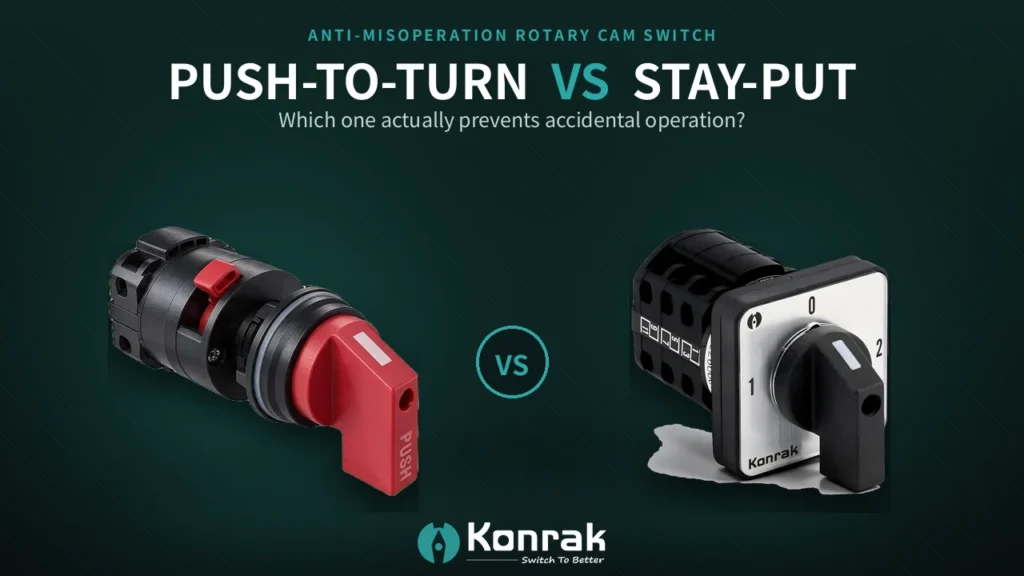
Short answer (the conclusion, up front): If preventing accidental operation is the requirement, only one design solves it at the mechanical level — the push-to-turn switch. A standard rotary (stay-put / detent) switch turns at the lightest touch; a momentary push button resets but does not force a deliberate two-step action. A push to turn switch cannot change position until the operator presses the lever or knob inward first, and when it includes a spring-return mechanism, it also resets automatically the moment the hand is released. Everything below explains why, and when to choose each type.
The three designs, in one line each
- Standard rotary (stay-put / detent): turn the handle to a position and it stays there. Fast, familiar, and ideal for continuous operation — but the handle can be bumped into another position.
- Momentary push button (spring return): press to actuate, release to reset. Great for a single deliberate command, but it takes only one motion to trigger.
- Push to turn (press-to-turn) spring return: press down to unlock rotation, turn to the desired position, release, and the spring returns it to neutral. Two deliberate actions plus automatic reset.
Side-by-side comparison
| Feature | Standard Rotary (Stay-Put) | Momentary Push Button | Push-to-Turn Spring Return |
| Accidental-operation risk | High — turns on any bump | Medium | Very low — rotation locked until pressed |
| Operator actions required | 1 (turn) | 1 (press) | 2 (press + turn) |
| Automatic reset | No — stays in position | Yes | Yes — springs back to neutral |
| Multi-position selection | Yes | Usually no | Yes |
| Suits safety interlocks / LOTO | Rarely | No | Yes — padlockable handle options |
| Best for | General-purpose switching | Single momentary commands | Error-sensitive, multi-position control |
Why it matters: the difference is not cosmetic. When a machine tool, transfer switch, or medical device changes state because of an accidental brush against a handle, the cost is downtime, scrap, or injury. Push-to-turn removes that failure mode by design, not by procedure.
Important: push-to-turn is a mechanism — not a single function
This is the point most buyers miss. Push-to-turn describes how you operate a switch, not what the switch does. The same push-to-turn mechanism can sit on top of many switching functions, including:
- Motor start / stop and reversing control
- Mode or selector switching (Auto–Off–Manual)
- Source changeover (mains–generator, utility–inverter)
- On/off isolation and emergency switching
- Instrument and transfer switching
So when you specify a push-to-turn switch, you are choosing two things: (1) an operation mechanism — push-to-turn, usually combined with a spring-return action — and (2) a switching function defined by the contact program (for example, 1-0-2 or 0-1). They are independent choices.
How to choose the right type
- Choose push-to-turn spring return when an accidental operation has real cost, when the switch must not stay in a dangerous position by mistake, or when the position must reset automatically after a momentary command.
- Choose stay-put (latching / maintained) when the selected position must be held — for example, keeping power on to a lighting circuit or a process line.
- Choose a momentary push button when the action is simple, single, and does not require position selection.
FAQ
Q: Does a push-to-turn switch always have spring return?
A: No — but they are commonly paired. Push-to-turn is the anti-misoperation step; spring return is the automatic-reset behavior. You can have push-to-turn with either a spring-return (momentary) or a latching (maintained) mechanism.
Q: Can a push-to-turn switch hold its position?
A: Yes, if it uses a latching mechanism instead of spring return. The push-down-to-unlock protection still applies; only the reset behavior differs.
Q: Is push-to-turn the same as stay-put?
A: No. Stay-put means the switch stays where you put it (a behavior). Push-to-turn means you must press before you can turn (a protection). A push-to-turn switch may be either momentary or stay-put once engaged.
Q: Are these switches standard-compliant?
A: Industrial rotary cam switches are typically rated to IEC 60947-3. Konrak’s LW26-20 series carries CE and TÜV certification as standard and is RoHS compliant; a UL certificate is also available, and UL-certified versions are priced differently from the standard CE/TÜV versions. Padlockable variants support lockout/tagout (LOTO).
Q: Where is push-to-turn most valuable?
A: Anywhere an unintended command is dangerous or expensive — machine tools, generators, ships, medical equipment, and automated production lines.
_____________________________________________________________________________________________
If your risk is accidental operation, only the push-to-turn design physically blocks rotation until the lever is pressed. Add spring return and you also get automatic, fail-safe reset. That is why push-to-turn spring-return switches are the standard choice wherever a single wrong move is one move too many.
Konrak’s LW26-20 push-to-turn spring-return rotary cam switch is rated 10A–32A, IEC 60947-3, with a 30° rotation angle and single-hole / 4-hole / DIN-rail mounting options. CE & TÜV certified, RoHS compliant; UL certification available (UL-certified versions priced differently). MOQ 100 pcs, 5-day lead time, OEM supported; main markets Europe and Southeast Asia. Switch To Better.