
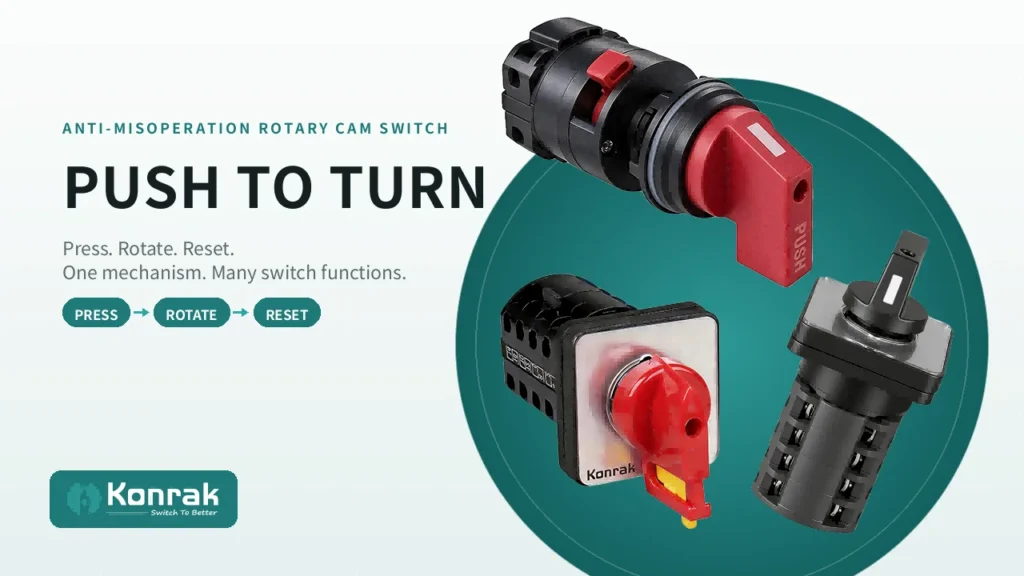
Definition (the answer, up front): A push-to-turn switch — also called a press-to-turn or push-to-operate switch — is a rotary switch that cannot change position unless the operator first presses the knob or lever inward and then rotates it. This deliberate two-step action is what prevents accidental or unintentional operation. Crucially, push-to-turn is an operation mechanism, not a single switch function: the switch underneath can perform many different functions (motor control, selector, changeover, isolation, and more). It is most often combined with a spring-return mechanism, so the switch automatically returns to neutral as soon as the operator lets go.
How it works: the press–rotate–reset cycle
- Press to engage. The operator pushes the knob or lever inward. A tactile click confirms engagement — this is the deliberate action that unlocks rotation.
- Rotate to activate. While holding the press, the operator turns the handle to the required position (e.g., 1-0-2 or 0-1).
- Spring return to neutral. On release, an internal spring automatically returns the handle to the neutral (off) position — so the switch never stays activated by mistake.
The result is a fail-safe, anti-misoperation control that removes both accidental triggering and the risk of an operator forgetting to reset the switch.
Mechanism vs. function: one mechanism, many functions
Push-to-turn tells you how the switch is operated. It says nothing about what the switch does. Common functions paired with the same push-to-turn mechanism include:
| Switch function | Typical use |
| Motor control | Start / stop, reversing |
| Selector / mode switch | Auto–Off–Manual |
| Changeover switch | Mains–generator, utility–inverter |
| Isolator / on-off | Safe isolation, emergency switching |
| Transfer / instrument switch | Signal or circuit transfer |
This is why specifiers choose two independent attributes: the operation mechanism (push-to-turn, usually with spring return) and the switching function (the contact program).
Spring return vs. latching: which behavior do you need?
| Spring Return (Momentary) | Latching (Maintained) | |
| Behavior | Resets to neutral on release | Stays in the selected position |
| Best for | Momentary commands, fail-safe reset | Continuous operation |
| Example | Trigger a machine cycle, then reset | Keep a lighting circuit energized |
Both can use the same push-to-turn protection; only the reset behavior differs.
Konrak LW26-20 push-to-turn spring return: model & mounting options
The Konrak LW26-20 press-to-turn spring-return rotary cam switch is available in seven mounting configurations, covering OFF-ON 2P and 1-0-2 1P contact programs:
| Mounting | Model | Configuration |
| Single hole, without face plate | LW26-20/320M2/1R4WOI.PT | OFF-ON, 2P |
| Single hole, with face plate | LW26-20/320M2/1R4S3I.PT | OFF-ON, 2P |
| 4-hole panel mounting | LW26-20/331C1/1R1S1I.PT | 1-0-2, 1P |
| 28 mm hole mounting | LW26-20/331C1/1R5WOB.PT | 1-0-2, 1P |
| 30 mm hole mounting | LW26-20/331C1/1R6WOB.PT | 1-0-2, 1P |
| 4-hole base mounting | LW26-20/331C1/1B1S1PR.PT | 1-0-2, 1P (padlockable handle) |
| DIN-rail base mounting | LW26-20/331C1/1B4S1I.PT | 1-0-2, 1P |
Certifications & compliance
- CE and TÜV: certified as standard across the LW26-20 range.
- UL: UL certification is available; note that UL-certified versions are priced differently from the standard CE/TÜV versions.
- RoHS: all products are RoHS compliant.
Commercial snapshot
| Item | Detail |
| MOQ | 100 pcs |
| Lead time | 5 days |
| OEM | Supported for standard models; custom structures negotiable |
| Main export markets | Europe and Southeast Asia |
Proven in the field
- Malaysia · TNB project — our LW26-20/330C1/1R1S1PR.PT helped a Malaysian customer win the TNB project, increasing their project bid success rate by 30%.
- Thailand · high-voltage switchgear — our LW26-20/320M2/1R4WOI.PT brought multiple project wins for a well-known high-voltage switchgear manufacturer in Thailand.
What to look for in a spec sheet
- Current rating — e.g., 10A–32A for a compact rotary cam switch.
- Standard — IEC 60947-3 (and UL 508 for North America where applicable).
- Rotation angle — a 30° angle is common on push-to-turn types, for precise, low-fatigue operation.
- Mounting — ø22mm single-hole, 36×36mm four-hole, or DIN-rail.
- Ingress protection — from IP20 (indoor panels) up to IP65 (dust and water).
- Positions / sequences — e.g., 1-0-2, 0-1, or Trip–Neutral–Close.
- Lockability — a padlockable handle supports lockout/tagout (LOTO).
Where push-to-turn switches are used
- Industrial manufacturing — machine tools, conveyors, assembly lines, where operators must activate equipment intentionally.
- Power & energy — generator changeover and solar/inverter switching, where an accidental change could drop a load.
- Transportation — elevators, railway signals, and gate controls, where a spring return guarantees the system resets.
- Medical & laboratory equipment — where a fail-safe reset prevents unintended activation during a procedure.
- Restricted or maintenance zones — padlockable versions lock the switch in OFF for safe servicing.
FAQ
Q: What is another name for a push-to-turn switch?
A: Press-to-turn, push-to-operate, or press-to-operate switch. In catalog terms it is often described as a push-to-turn spring-return rotary cam switch.
Q: Can it change position without being pressed?
A: No. Blocking rotation until the lever is pressed is the whole point of the design — it is the anti-misoperation feature.
Q: Does it reset by itself?
A: Yes, when it includes a spring-return mechanism. Latching versions hold position instead.
Q: Is it the same as an emergency stop?
A: Not exactly. An e-stop is a dedicated safety function; a push-to-turn switch is a control device whose two-step operation reduces misoperation. On safety-critical panels, the two are often used together.
Q: Is push-to-turn only for high-current switches?
A: No. It is an operation mechanism available across a range of current ratings and functions.
Q: What certifications does the Konrak LW26-20 carry?
A: CE and TÜV are standard, and all products are RoHS compliant. UL certification is also available; due to the additional certification, UL-certified versions are priced differently from the standard CE/TÜV versions.
Q: What is the MOQ and lead time, and do you support OEM?
A: MOQ is 100 pcs with a 5-day lead time. OEM is supported for standard models, and custom structures are negotiable. Main export markets are Europe and Southeast Asia.
The bottom line
A push-to-turn switch is best understood as a safety-by-design operation mechanism: press, then turn, then let it reset. Because it separates how you operate the switch from what the switch does, it can protect almost any rotary-switch function — which is why it has become the default wherever accidental operation is unacceptable.
Konrak’s LW26-20 push-to-turn spring-return rotary cam switch — 10A–32A, IEC 60947-3, 30° rotation, seven mounting options. CE & TÜV certified, RoHS compliant; UL certification available (UL-certified versions priced differently). MOQ 100 pcs, 5-day lead time, OEM supported. Switch To Better.