
A story that reaches us maybe twice a year, always with small variations. A maintenance fitter opens a machine guard because the run light on the panel is dark. The light is dark because a timer dropped out, not because anyone isolated the line. He is two seconds from putting his hand into a machine that is still live.
In the version we hear most often, what stops him is another fitter walking past and asking a stupid question.
Nothing in that story is unusual, and no one involved was careless. The panel light was working exactly as designed. The isolator was working exactly as designed too — it was simply forty metres away, in a different room, behind a door with no window. A device that is not where the work is does not isolate anything. It just documents an intention.
That is the whole case for local isolation, and it is why the least interesting component in the switchboard is often the one holding the whole safety argument together.
What the thing actually does
An enclosed isolator — what we call a switch disconnector, and what most of Europe calls a disconnector or an isolator — does three things: it makes a circuit, it breaks a circuit under normal load, and it leaves a gap you can see. That last one is the part people underestimate. You are not buying a switch. You are buying the right to say, out loud, “this is dead, and here is the proof.”
Where it stops is just as important, because catalogues blur the line and buyers get caught by it.
| The job | Isolator | Breaker / fuse |
|---|---|---|
| Visible break in the circuit | Yes — that’s the point | No |
| Switching normal load current | Yes (load-break version) | Yes |
| Interrupting a short circuit | No, and it must not be asked to | Yes |
| Overload protection | No | Yes |
| Giving maintenance a lockable point | Yes | Usually not |
Two devices, two jobs. When a supplier offers you an isolator as “protection”, they either do not know the difference or hope you don’t. When a customer asks us to rate an isolator for fault current, we say no and lose the line item, because the alternative is being blamed for a fire eighteen months later.
Where the words get loose
Half the confusion in this category is linguistic rather than electrical. The same device appears in catalogues as an isolator, a disconnector, a switch disconnector, a load-break switch, a main switch, and a maintenance switch — sometimes all six in one document, sometimes for the same part number.
For the UK and EU, two things are worth pinning down. IEC 60947-3 is the international text that defines how a switch, disconnector or switch-disconnector is rated and tested. EN 60947-3 is the European harmonised version that CE marking points to. They say the same thing in the parts that matter, and if a technical buyer asks which one you comply with, the correct answer is both, with a test report attached. If a supplier can only produce a certificate for the enclosure and not for the switching device, you have found the gap in their file.
One more piece of vocabulary that decides whether your switch survives: utilization category. We will get to it — it matters more than the amp figure on the front of the box.
Reading the lever from across the room
Here is a design brief you will not find in a datasheet: a fitter in a steel mill, wearing gloves, in a corner lit by one sodium lamp, at three in the morning, has to know whether the machine he is about to reach into is live.
Every decision in an isolator’s front face is an attempt to answer that in under a second.
- Ninety degrees, detented. A quarter turn between OFF and ON, with a positive click at each end and nothing credible in between. Smooth travel is a nice feel in a showroom and a liability on a Tuesday night shift.
- Red on yellow. Not decoration. Dark red lever on a bright yellow lid is the highest-contrast combination available in industrial paint, and it reads at distance far better than grey on grey.
- 0 and I, engraved. Printed labels fade, peel and get painted over during refurbishment. Engraved or moulded symbols are still there in year fifteen.
- Position visible from the side. A lever that only reads face-on is useless if the switch is mounted on a panel edge, which is exactly where it usually ends up.
- Enough grip for a glove. A bar handle of roughly 40 mm, not a knurled knob designed around a bare thumb.
None of that is expensive. All of it is optional, which is why it is the first thing a cheap switch loses. If you want a fast test in a showroom, stand three metres away and ask a colleague to tell you which position the switch is in. If they hesitate, the design has failed before it ever gets installed.
The padlock has to be built in, not added
Lock-out/tag-out fails in practice for one reason that has nothing to do with safety culture: friction. If applying a lock takes longer than the job itself, the lock does not get applied. Nobody announces that decision. It just quietly does not happen, on a Friday, for a five-minute adjustment.
So the padlock point is not an accessory. It is the part of the design that decides whether your LOTO procedure is a procedure or a habit.
What that means physically: a hasp or lever hole that takes a standard 6 mm padlock shackle without forcing, positioned so a gloved hand can reach it with the switch in the OFF position, and geometry that makes it impossible to move the lever to ON while a lock is fitted. Not difficult to close the switch. Impossible.
One fitter, one padlock, one key. The line stays dead until the last key comes off — and the switch itself should be the thing that enforces it, not the supervisor.
Where work involves more than one trade, the practice that actually holds is a group lock box: every person puts their own lock on the box, the box holds the key to the isolation point, and the line cannot be restored until the last lock comes off. It only works if the device has a hasp worth hanging a box’s worth of trust on.
Water, dust and the parts that fail first
Mechanical wear is rarely why an isolator on a plant wall dies. What kills it is what gets in, and what the summer does to the gasket that was supposed to keep it out.
IP65, the rating most enclosed isolators carry, means two specific things: completely protected against dust, and protected against water jets from any direction — a 6.3 mm nozzle at 12.5 litres a minute, held a few metres away for three minutes. Note what it does not mean: it is not a claim about temporary immersion (that is IP67), and it is not a claim about steam, high-pressure cleaners, or the inside of a car wash. If your washdown routine involves a 100-bar lance at 200 mm, buy IP66 or better, or put the switch somewhere else.
The failure points are boringly consistent: a hinge that rusts and stops compressing the gasket; a cable gland tightened by hand and never checked; a lid seal that goes hard after three summers of UV and then takes a set. Cover UV stability in the specification and you avoid most of it. Ignore it and the switch will still work — it will just be full of water when someone opens it in year six.
Cold rooms are their own case. Condensation forms on the inside of the lid when a warm, humid day meets a cold enclosure, and the drain path matters more than the IP number. If the enclosure is going into a freezer or a washdown zone, say so before ordering, not after the first inspection.
Amps are not the whole rating
Two switches can both say 32 A and be completely different products. The number on the front of the box is a thermal current, and it tells you almost nothing until you know what it is switching.
IEC 60947-3 rates load-break switches by utilization category, which is shorthand for “how brutal is this load”.
| Category | Typical load | What changes |
|---|---|---|
| AC-21A | Resistive loads, light overload — heaters, lighting | Easiest duty, highest current rating |
| AC-22A | Mixed resistive and inductive, moderate overload | Current rating drops |
| AC-23A | Motor loads and other highly inductive circuits | Lowest current rating, real motor duty |
Before you ask anyone for a price, get these six things on one line of paper:
- utilization category (AC-21A, AC-22A or AC-23A)
- rated current at your operating voltage — not at a catalogue voltage
- poles, and whether the neutral is switched
- mounting: enclosed, panel, or base/DIN
- environment: indoor panel, plant room, or outdoor yard
- whether a padlock has to fit, and whose padlocks
The trap is simple. A switch rated 32 A in AC-21A is not a 32 A motor switch. Put it in front of a 15 kW motor and you have an under-rated device that will pass the FAT, run for a year, and fail in a way that is hard to explain to a warranty department. Ask for the category, not just the amps — and write the category on the purchase order. It costs you nothing and it ends arguments later.
Watch
If you would rather see the hardware than read about it, start here.
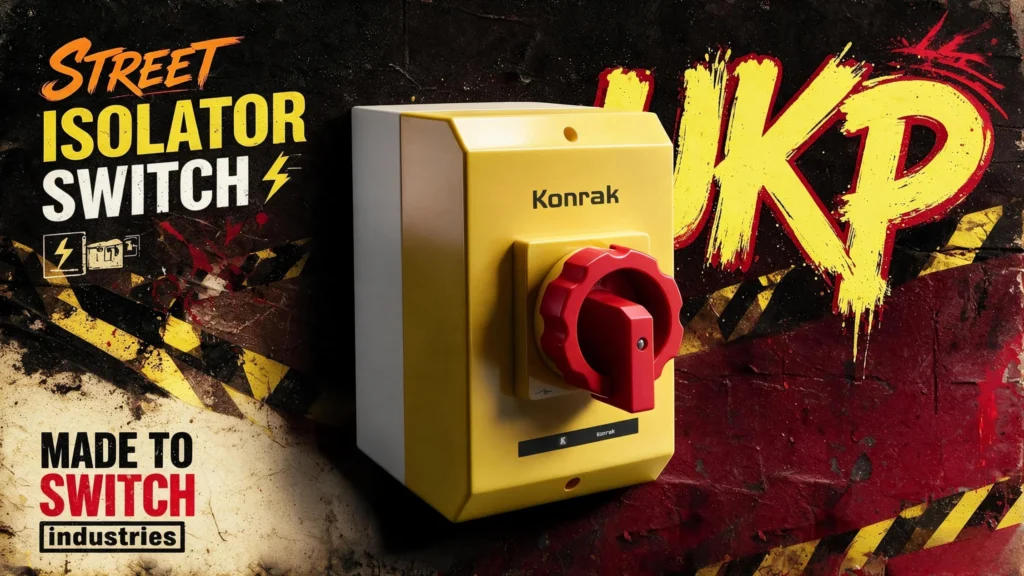
Konrak UKP — enclosed rotary load-break isolator switch.
Where they end up
In practice, the UKP turns up wherever a machine or a circuit needs its own local, lockable off-switch — and the pattern is usually that someone has already been inconvenienced by not having one.
Plant rooms are the classic case: air-handling units, ventilation fans, chilled-water pumps. Nobody wants to walk back to the main board to isolate a fan, so nobody does, so the fan gets worked on live. Water and wastewater sites add their own flavour of misery — outdoor enclosures, wet floors, a pump that has to be isolated on a Sunday.
Then there is the ordinary workhorse duty: a local switch beside a small AC motor, with the starter in the panel and the fitter’s hand on neither. Machine isolation for guard changes, belt changes, die changes — the two-minute jobs where the LOTO ritual has to be easier than skipping it. Distribution and control panels, where the switch is either the main switch or the visible break in front of a drive. Reefer container sockets, construction switchboards, temporary power in permanent weather.
Lift motor rooms and lift pits deserve a mention, with one caveat: an isolator beside a lift is part of a safety system that also involves inspection controls and the pit switch, and every part of it is specified by the lift standard, not by the switch supplier. Buy the switch from someone who knows what they are being asked to do in that circuit.
One boundary worth stating out loud, because it catches people coming from solar: a standard AC isolator is not a DC isolator. Photovoltaic strings and battery circuits need a device rated for DC, with DC arc-quenching, at the correct voltage. If someone is specifying a UKP for a PV array, stop them and check the DC question first.
Five things buyers get wrong
- Buying on amps alone. Category and voltage decide more than the headline current. See above — it is the most expensive mistake on this list because it passes inspection.
- Treating the isolator as the lock-out system. The padlock point is one link. Tags, training and one-key-per-person are the rest, and no switch fixes a procedure nobody follows.
- Mixing sealed and unsealed hardware. A perfectly good IP65 switch bolted to a box with an unsealed gland is an unsealed installation with extra steps.
- Buying the cheapest enclosure for an outdoor job. The enclosure is the part that dies first, and it takes your reputation with it — usually two years later, when the gasket has gone hard.
- Forgetting earth and neutral in the quote. They are on the drawing. They are almost never in the first price.
How the UKP is put together
The UKP is our enclosed rotary isolator: a 90° OFF/ON action with a positive break, a dark red lever on a yellow lid so the state reads from a distance, a padlockable OFF position, and a sealed enclosure meant for real plant conditions rather than a showroom. Terminals are laid out with enough room to land a cable without inventing new swear words, and the base and lid take a knock.
| Specification | UKP series |
|---|---|
| Standard | IEC / EN 60947-3 |
| Poles | 2P / 3P / 4P / 5P |
| Rated current | [ fill from data sheet ] |
| Rated voltage | [ fill from data sheet ] |
| Utilization category | [ AC-21A / AC-22A / AC-23A ] |
| Enclosure | IP65, UV-stable, impact-resistant base and lid |
| Operation | 90° rotary, padlockable in OFF, red lever on yellow lid |
Because we build these as rotary cam switches rather than buying them in, the parts customers usually cannot get changed are the parts we would rather make ourselves: the position sequence, the number of positions, the angle between them, the engraving on the face, the pole arrangement, and the colour of the lid. If you have a panel drawing and a truth table, that is enough to quote from.
Questions we actually get asked
Can an isolator be used as a main switch?
Yes, if it is rated for the installation’s load and it is acceptable to your local code as the means of isolation. What it cannot do is double as the protective device. The breaker or fuses sit alongside it and handle fault current.
Is IP65 enough for outdoor use?
For rain, dust and general outdoor exposure, yes. For high-pressure washdown, steam, or anything that will sit in standing water, no. Tell us the environment and we will tell you honestly whether the standard enclosure is the right answer.
Why does the same switch have different current ratings?
Because the rating depends on the duty. The same contacts are comfortable switching resistive load at one current and motors at a lower one. That is what the utilization categories in IEC 60947-3 describe, and it is why the category belongs on the purchase order.
Can you engrave the face with our own wording?
Yes. Position text, language, symbols, and the client’s own mode names are all part of the tooling. Send the panel drawing. This is usually the difference between a catalogue part and something that slots into an existing machine without relabelling.
What is the lead time?
Standard configurations ship from stock. Custom engraving and non-standard pole arrangements add a few days rather than weeks, because the switching elements are made here. Ask for a date with your quote, not after it.
None of this is complicated. A switch that can be locked is a promise, and a switch whose position can be read from across the room is a warning. Everything else on the datasheet — the amps, the IP number, the certification — exists to make sure those two things keep working for the next twenty years.
If your next project needs isolators and you would rather not spend a week comparing catalogues, send us the load, the environment and the mounting. You will get a specification back, not a brochure.
Tell us the load, the environment and the mounting — we’ll come back with a configured switch and a date.
Talk to Konrak →