
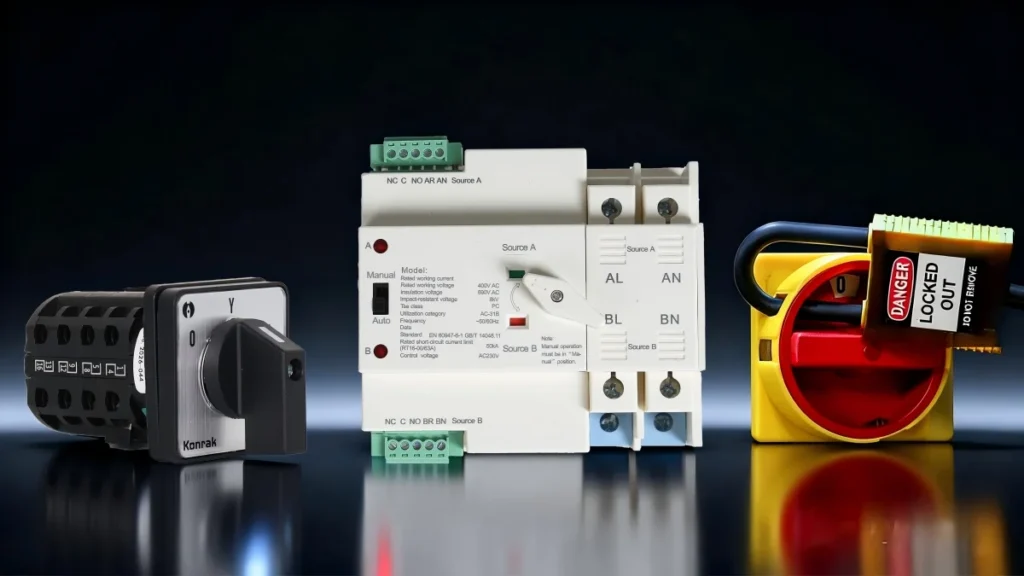
Choosing between a cam switch vs changeover switch vs isolator is simpler than it looks once you know what each device is designed to do. In one sentence: a cam switch is a multi-position control device, a changeover switch transfers a load between two sources, and an isolator safely disconnects a circuit with no load. If your panel needs multi-speed motor control, you need a cam switch; if it must transfer between generator and mains, you need a changeover switch; if it must be locked out for maintenance, you need an isolator.
Getting the boundary wrong means arcing, welded contacts, or an unsafe maintenance condition. Konrak covers all three functions from one manufacturer: the LW26 cam switch series spans 10A to 160A, and the main switch and disconnect range spans 20A to 100A to IEC 60947-3 / EN 60947-3. The utilization category tells you which duty a switch is actually rated for — AC-21A for resistive loads, AC-22A for mixed loads, and AC-23A for motor loads.
Table of Contents
1. Cam Switch vs. Changeover Switch vs. Isolator: The Key Difference
2. What Does a Cam Switch Do?
3. What Does a Changeover Switch Do?
4. What Does an Isolator Do?
5. How Do They Compare?
6. Can One Product Do All Three?
7. Three Questions That Decide the Choice
8. Common Mistakes When Choosing Between Them
9. Summary: Which Do You Actually Need?
10. Frequently Asked Questions
Cam Switch vs Changeover Switch vs Isolator: The Key Difference
The three names describe three different jobs, not three levels of quality. A cam switch controls a machine through multiple positions. A changeover switch moves one load between two sources. An isolator makes a circuit safe to work on. Each job demands different contact logic, different load ratings, and different certification — which is why the answer cannot be a single product name.
What Does a Cam Switch Do?
- Multi-position rotary control: DOL starting, reversing, star-delta, speed selection, test equipment, HVAC, welding machines.
- Fixed cam profile: the cam profile drives contacts open and closed in a fixed sequence, so one switch replaces several contactors for low-cost control.
Inside a cam switch, shaped cams on a common shaft open and close contact groups as the handle turns. Because the sequence is mechanical, it repeats exactly on every operation — no wiring mistakes, no logic drift. That is why cam switches are the workhorse of machine tool control. To see how the contacts are built, read our guide to the internal structure of rotary cam switches.
What Does a Changeover Switch Do?
- Transfers one load between two sources: generator-to-mains or mains-to-mains.
- Break-before-make contact logic prevents the two sources from being paralleled.
- Typical in distribution cabinets, standby power, and marine panels.
Changeover is an on-load transfer duty. When a generator takes over from the mains, the switch must disconnect one source completely before connecting the other. Break-before-make logic guarantees the two sources are never connected at the same instant, which protects both the generator and the grid-side breakers. In marine and standby power panels, this function is often combined with a cam switch platform such as the LW26 series.
What Does an Isolator Do?
- Disconnects a circuit for maintenance — it is an off-load device, not a switching device.
- Must comply with IEC 60947-3 and be clearly marked with its open/closed position.
- Konrak’s disconnect switches cover 20A to 100A to IEC 60947-3 / EN 60947-3.
An isolator is opened only when the circuit is already de-energized. Its job is to guarantee a visible, lockable gap so maintenance staff can work safely. That is why the standard is strict: the IEC 60947-3 standard defines the disconnector requirements, and independent bodies such as TÜV SÜD verify compliance with test reports.
How Do They Compare (Cam Switch vs Changeover Switch vs Isolator)?
The table below summarizes the load condition, typical use, and utilization category for each function. Read the load-condition column first — it decides most selections.
| Function | Load condition | Typical use | Utilization category |
| Cam switch | On-load control, multi-position | Motor control, machine tools | AC-21A/22A/23A, AC-3, AC-4 |
| Changeover switch | On-load transfer between sources | Generator/mains changeover | AC-21A/22A/23A |
| Isolator | Off-load isolation | Maintenance, safety lock-out | IEC 60947-3 disconnector |
Notice that the changeover switch and the isolator sit at opposite ends of the load spectrum. One operates under load by design; the other must never be operated under load. Mixing them up is the single most common cause of arcing damage on panel switches.
Can One Product Do All Three?
- A cam switch with the right contact logic performs cam switch and changeover duties — the LW26 covers both.
- For a dedicated isolator function, choose the main switch / disconnect range (20A–100A).
- Ask: what must this panel do, and under load or not? The answer selects the product.
In practice, many panels need two products: one cam or changeover switch for the live control duty, and one isolator for the maintenance isolation. The LW26 cam switch series handles the control side from 10A to 160A, while the main switch and disconnect range covers 20A to 100A for isolation duties. Both come from the same manufacturer, so ratings and certification documents stay consistent.
Three Questions That Decide the Choice
- Will the switch operate under load? If yes, you need a cam switch or changeover function; if no, an isolator may be enough.
- How many positions does the operator need? Two sources or two speeds point to changeover or 2-position cam duty; three or more positions point to a multi-position cam switch.
- Is safety lock-out required? A visible-open disconnect with clear position marking is mandatory for maintenance isolation.
Answer these three questions in order and the correct product name appears by itself. The first question alone eliminates half the catalog.
Common Mistakes When Choosing Between Them
- Using an isolator as a cam switch — switching an isolator under load causes arcing and contact damage.
- Using a cam switch as an isolator — control switches may not provide a guaranteed visible open gap.
- Ignoring break-before-make logic — paralleling generator and mains can destroy both sources.
- Reading the utilization category last — AC-21A, AC-22A, and AC-23A ratings are not interchangeable.
Each mistake maps to one of the three questions above. If you answer the questions first, the mistakes disappear. For more context on where these devices are used, see our overview of rotary cam switches in use across industries.
Summary: Which Do You Actually Need?
In short, matching the switch to the duty is a matter of asking the right questions, not memorizing catalogs. The LW26 series covers 10A to 160A control duties, and the disconnect range covers 20A to 100A isolation duties. Use this quick checklist:
- Under load, multi-position control → cam switch (LW26 series).
- Under load, transfer between two sources → changeover switch function.
- Off-load isolation for maintenance → isolator (20A–100A disconnect range).
- Always confirm the utilization category (AC-21A / AC-22A / AC-23A) against the real load.
Konrak can help you match the product to the duty — send your panel function to davy@konrak.com or browse www.konrak.com.
Frequently Asked Questions
Can an isolator be used as a changeover switch?
No. An isolator is an off-load device and cannot transfer load between two live sources. Use a changeover switch function with break-before-make logic for source transfer.
Is a changeover switch the same as a cam switch?
Not exactly. A changeover switch is a function (transfer a load between two sources), while a cam switch is a mechanism. Many changeover switches are built on cam switch platforms, like the LW26 series.
Which utilization category do I need for a generator changeover?
For generator-to-mains transfer of resistive and lightly inductive loads, AC-21A or AC-22A is typical. Confirm the load type and the switch’s Ie rating at your voltage before ordering.