
A reliable rotary cam switch selection starts with a proven five-step process: define the application, choose the current and voltage ratings, decide the poles and contact arrangement, match the utilization category, and verify certification. Work through these steps in order, and you will avoid the two most common buying mistakes — oversizing that wastes panel space and budget, and undersizing that causes premature failure. This guide is written for engineers and buyers who need a switch that is right the first time.
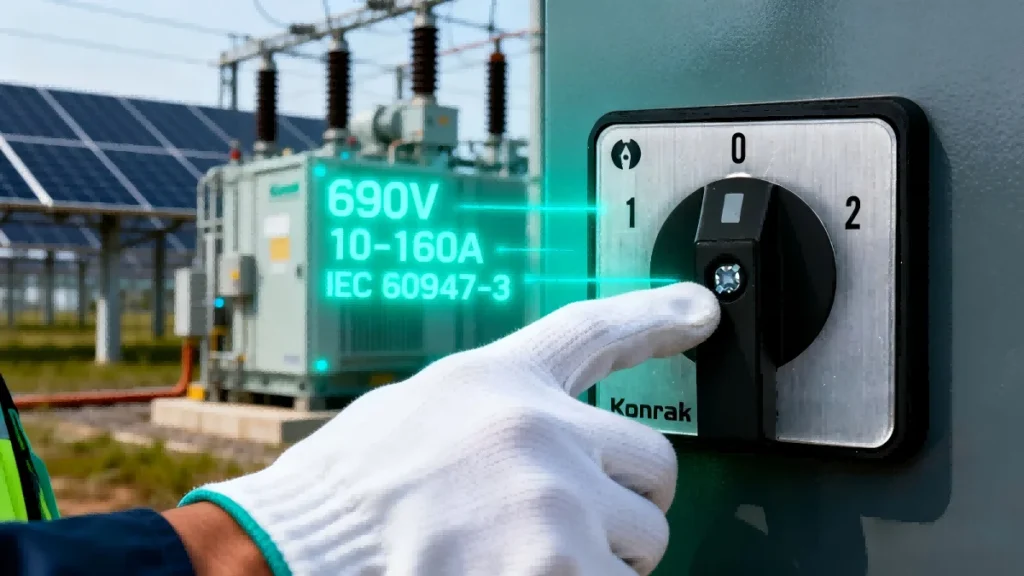
Two numbers anchor the whole exercise. Konrak’s LW26 series covers 10A to 160A, and the models from 10A to 63A have been tested by TÜV SÜD against IEC 60947-3:2020. Every model carries a rated insulation voltage (Ui) of 690V and a rated impulse withstand voltage (Uimp) of 2.5kV. Start with the application, and the rest of the specification follows naturally.
Table of Contents
1. The Rotary Cam Switch Selection Process in 5 Steps
2. Step 1: What Is the Switch Actually Doing?
3. Step 2: Which Current and Voltage Ratings?
4. Step 3: How Many Poles and What Contact Arrangement?
5. Step 4: Which Utilization Category?
6. Step 5: What Certification Backs the Datasheet?
7. Common Rotary Cam Switch Selection Mistakes
8. Summary: Your Rotary Cam Switch Selection Checklist
9. Frequently Asked Questions
The Rotary Cam Switch Selection Process in 5 Steps
Every selection follows the same logic, whether you are specifying a changeover switch for a generator, a motor switch for a conveyor, or an isolator for a solar array. The five steps below turn a long datasheet into a short checklist. For a closer look at how these switches are built, see our guide to the internal structure of rotary cam switches.
[IMAGE: 1 – LW26 rotary cam switch close-up]
ALT text: “rotary cam switch selection guide LW26 series”
Insert a product photo of the LW26 switch with teal brand lighting.
Step 1: What Is the Switch Actually Doing?
The function decides everything downstream, so write it down before you open a catalog. In practice, most applications fall into one of three groups:
- Changeover between two supplies (generator-to-mains, mains-to-mains) needs break-before-make contact logic, so the two sources can never be connected at the same moment.
- Motor control — DOL starting, reversing, star-delta, speed selection — needs the AC-3/AC-4 duty ratings that match the motor’s inrush current.
- Isolation for maintenance and PV DC isolation need a switch-disconnector built to IEC 60947-3 with a clear OFF position.
For example, a hospital transfer switch must guarantee break-before-make behavior, while a solar DC isolator must be rated for DC switching. If you skip this step, the rest of the specification has no anchor. Take a look at the LW26 rotary cam switch series to see how one platform covers all three duties.
Write the function down before you open a catalog; it decides everything downstream.
Step 2: Which Current and Voltage Ratings?
Two ratings are easy to confuse. Ith (thermal current in free air) is the frame rating — it tells you how much current the switch can carry continuously. Ie (operational current) is what the switch can actually switch at the rated voltage in a given utilization category. Size from Ie, not from Ith, because Ie reflects the real switching duty.
- Example — LW26-32: 32A in AC-21A/AC-22A, 30A (15kW) in AC-23A, 22A (11kW) in AC-3, 11A (5.5kW) in AC-4 at 440V.
- Konrak’s LW26 series: Ui 690V, Uimp 2.5kV, Ue 440V, 50/60Hz, standard 4-pole, with other pole counts available on request.
In practice, a motor starting at 22A inrush may only need an 11A switch if it is switched rarely — but only if the AC-4 rating fits the duty cycle. When in doubt, choose the rating one step up; it costs less than a premature contact replacement.
Step 3: How Many Poles and What Contact Arrangement?
Most panel applications start from 4 poles. Motor reversing and star-delta applications need more, and specialized duties need non-standard contact sequences that a standard catalog page cannot show. That is why Konrak’s customization service covers non-standard contact arrangements, custom silkscreen, and logo marking. The company’s principle is “You Design It, We Make It,” even for small orders.
- 4 poles: standard changeover and isolation duties.
- 6–8 poles or more: reversing, star-delta, and multi-speed motor control.
- Custom sequences: non-standard cam profiles produced on request for OEM projects.
Step 4: Which Utilization Category?
The utilization category defines what the switch is allowed to switch. AC-21A suits resistive loads such as heaters. AC-22A covers mixed resistive-inductive loads. AC-23A is for motors and highly inductive loads, and AC-3/AC-4 describe motor switching duties with different contact wear characteristics.
- AC-21A for resistive loads.
- AC-22A for mixed resistive-inductive loads.
- AC-23A for motors and highly inductive loads.
- AC-3/AC-4 for motor switching duties (starting, inching, plugging).
Never take an AC-21A rating and apply it to a motor. The switching duty is completely different, and the contacts will wear early — often within weeks on frequent start-stop cycles.
Never take an AC-21A rating and apply it to a motor — the switching duty is completely different and the contacts will wear early.
Step 5: What Certification Backs the Datasheet?
Ask for original third-party test reports, not a self-declaration. Konrak’s LW26 models from 10A to 63A are covered by TÜV SÜD reports 874102301401-00, 874102301402-00, and 874102301403-00 (issued March 2023) against IEC 60947-3:2020, satisfying EN IEC 60947-1:2021 and EN IEC 60947-3:2021. The series extends to 160A, so confirm which models carry the reports for your rating.
Certification matters because it is the evidence behind the numbers. Read the official IEC 60947-3 standard to understand what the tests cover, and check how the
independent tests are performed by TÜV SÜD before you compare quotes.
[IMAGE: 2 – TUV SUD test certificate excerpt]
ALT text: “rotary cam switch selection TUV SUD certificate IEC 60947-3”
Optional: a cropped certificate image builds trust.
Common Rotary Cam Switch Selection Mistakes
Even experienced buyers repeat the same mistakes when choosing a switch. The four most common ones are:
- Oversizing wastes panel space and budget, and can make the switch harder to operate.
- Undersizing causes overheating, contact welding, and premature failure.
- Ignoring the utilization category leads to contacts that wear out far too early.
- Accepting self-declared certificates instead of third-party reports puts your compliance at risk.
The fix is simple: follow the five steps in order, and keep the datasheet evidence for your quality file. For more application context, you can also read about rotary cam switches in use across industries.
Summary: Your Rotary Cam Switch Selection Checklist
A disciplined selection process takes less than an hour and saves weeks of downtime later. Here is the checklist:
- Define the application and write the switching function down.
- Size from Ie and the utilization category, not from Ith alone.
- Confirm the pole count and contact sequence, including custom needs.
- Match the utilization category to the real load.
- Demand original third-party test evidence (TÜV SÜD reports for LW26 10A–63A).
Konrak will share its TÜV SÜD test reports before you order. Email davy@konrak.com or visit www.konrak.com to get them.
Frequently Asked Questions
What is the difference between Ith and Ie?
Ith is the thermal current the switch can carry in free air; Ie is the operational current it can switch at rated voltage in a given utilization category. Always size from Ie.
Can I use an AC-21A switch for motor control?
No. AC-21A is rated for resistive loads only. Motor circuits need AC-23A or AC-3/AC-4 ratings, otherwise the contacts will wear early.
Which LW26 models are TÜV SÜD certified?
The 10A to 63A models are covered by TÜV SÜD reports 874102301401-00, 874102301402-00, and 874102301403-00 against IEC 60947-3:2020. Models above 63A are part of the series up to 160A — ask Konrak which reports apply to your rating.
This entry was posted in Rotary Cam Switch and tagged Selection Guide, IEC 60947-3, LW26 Series, TUV SUD.