
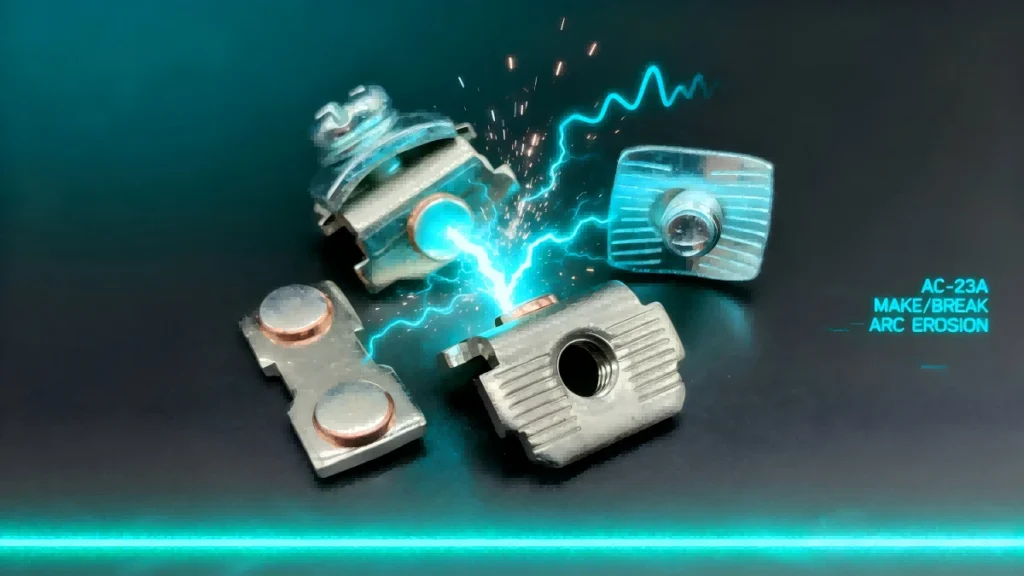
Cam switch contact material is the single biggest determinant of a switch’s temperature rise, contact resistance, and electrical life — and silver alloy is the configuration used in premium switches. Silver-alloy contacts combine low contact resistance with strong resistance to arc erosion, which is exactly what a switch making and breaking current thousands of times needs. In this buyer’s guide we compare silver alloy against silver-plated and pure silver contacts, and we show the test data behind the choice.
Konrak fits silver-alloy contacts across the LW26 series, and the TÜV SÜD test reports confirm the benefit in measurable terms: terminal temperature rise on the LW26-32 and LW26-40 is around 36–40K, and even the largest tested models, LW26-50 and LW26-63, stay at 54–58K — all far below the 80K limit of IEC 60947-3. That margin is the difference between a switch that runs cool for decades and one that degrades its contacts early.
Table of Contents
1. Why Cam Switch Contact Material Matters
2. Silver Alloy vs. Silver-Plated vs. Pure Silver
3. Why Silver Alloy Is the Premium Configuration
4. What the TÜV SÜD Data Show
5. How Temperature Rise Affects Real Reliability
6. What to Ask Your Supplier
7. Summary: The Evidence-Based Checklist
8. Frequently Asked Questions
Why Cam Switch Contact Material Matters
Every time current flows through a cam switch, the contact joints produce heat. The amount of heat depends on contact resistance, and the resistance depends on the material and its surface condition. That is why cam switch contact material is not a spec line to skim — it is the component that determines how long the switch survives.
- Contact resistance generates heat at every current-carrying joint; higher resistance means higher temperature rise.
- IEC 60947-3 sets an 80K terminal temperature-rise limit; exceeding it accelerates oxidation, softens springs, and shortens life.
- Arc erosion at make/break removes contact metal on every operation — the material must resist it.
Silver Alloy vs. Silver-Plated vs. Pure Silver
Three materials dominate the market. The table below compares their contact resistance, arc erosion resistance, and typical use so you can match the material to the duty.
| Material | Contact resistance | Arc erosion resistance | Typical use |
| Silver alloy | Low, stable over life | High | Premium cam switches, high cycle counts |
| Silver-plated | Low initially | Moderate; plating wears | Cost-sensitive, light duty |
| Pure silver | Very low | Lower; softens and welds more easily | Specialized low-current use |
The key difference is stability over life. Silver-plated contacts start with low resistance, but the plating wears after thousands of operations, exposing the base metal and driving resistance up. Silver alloy keeps its resistance low for the entire service life, which is why it appears in premium cam switches and high-cycle applications.
Why Silver Alloy Is the Premium Configuration
- Keeps low contact resistance over the whole life, not just on day one.
- Withstands repeated arcing in AC-3/AC-4 motor duty.
- Supports the high thermal margins measured in testing.
In motor duty, the switch makes and breaks current under load, and every break draws an arc that vaporizes a tiny amount of contact metal. Silver alloy is formulated to resist exactly this erosion, so the contact shape — and therefore the contact pressure and resistance — stays within spec far longer. This is the practical reason the LW26 series uses silver alloy across the whole range from 10A to 160A. You can see the full series in our LW26 rotary cam switch range.
What the TÜV SÜD Data Show
- LW26-10/16/20: terminal temperature rise ≤41K.
- LW26-32/40: ≤40K.
- LW26-50/63: ≤58K (limit 80K).
- Impulse withstand measured at 2.98kV against a 2.5kV requirement.
The temperature-rise figures come from original test reports issued against IEC 60947-3, not from a self-declaration. The impulse withstand result of 2.98kV against a 2.5kV requirement adds a 19% margin, which confirms the insulation design has headroom. Independent testing by TÜV SÜD gives buyers evidence they can put in their quality file.
How Temperature Rise Affects Real Reliability
- Extra terminal heat accelerates oxidation and contact degradation; the difference between 40K and 70K is not a linear stress increase but a much larger life penalty.
- High temperature also softens the return springs that restore contact pressure, which raises contact resistance further in a self-reinforcing cycle.
- This is why the measured margin in a test report is a reliability statement, not a paperwork formality.
Think of temperature rise as a compounding factor. A switch running 40K hotter does not simply age proportionally faster; oxidation and spring softening feed each other until the contact fails unexpectedly. The margin between 58K and the 80K limit is the safety buffer that keeps the LW26 switches predictable across their rated life.
The measured margin in a test report is a reliability statement, not a paperwork formality.
For context on where these switches run their duty cycles, see our overview of rotary cam switches in use across industries.
What to Ask Your Supplier
- “What is the contact material, and can I see the temperature-rise data from your test report?”
- If the answer is “silver alloy” but no report exists, ask for evidence.
A datasheet can claim anything; a test report cannot. Ask for the original report number, the test standard, and the measured temperature-rise figures for the exact model you are buying. For a deeper look at how the contacts are assembled inside the switch, read our guide to the internal structure of rotary cam switches.
Summary: The Evidence-Based Checklist
Choosing a cam switch contact material comes down to one principle: demand evidence, not adjectives. Use this checklist when comparing quotes:
- Confirm the contact material is silver alloy, not silver-plated.
- Check the terminal temperature rise against the 80K limit of IEC 60947-3.
- Ask for the original TÜV SÜD report number for your exact model.
- Compare the impulse withstand margin (LW26: 2.98kV vs 2.5kV requirement).
Konrak publishes its test results and will walk you through the data — contact davy@konrak.com or visit www.konrak.com.
Frequently Asked Questions
Do silver-alloy contacts wear out?
All contacts wear over time, but silver alloy resists arc erosion far better than silver-plated or pure silver. In motor duty (AC-3/AC-4), silver-alloy contacts keep their shape and resistance much longer, which is why they are the premium choice.
When is silver-plated acceptable?
Silver-plated contacts suit cost-sensitive, light-duty applications with low cycle counts, where the plating will not wear through during the product life. For high-cycle or motor switching, silver alloy is the safer choice.
What temperature rise is normal for a cam switch contacts?
IEC 60947-3 sets a terminal temperature-rise limit of 80K. The LW26 series measures about 36–40K on mid-range models and 54–58K on the largest tested models, leaving a comfortable margin.