
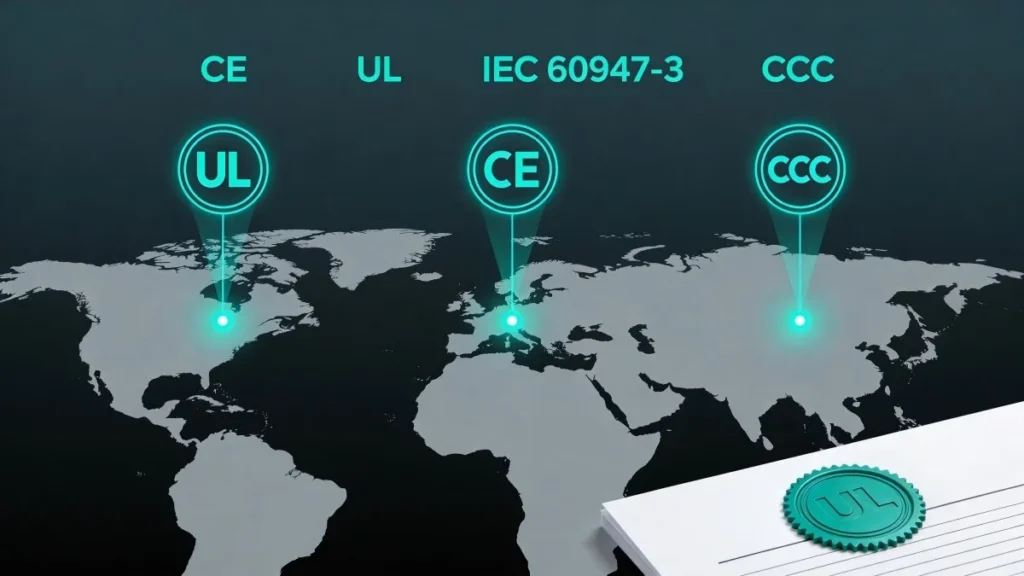
Cam switch certification is not a single stamp — CE, UL, IEC 60947-3, and CCC each serve a different market and a different purpose. In brief: CE (LVD) is required to sell low-voltage equipment in the European Economic Area; IEC 60947-3 is the international product standard for switches, disconnectors, and switch-disconnectors; EN IEC 60947-3 is its European harmonized twin; UL is the North American certification regime; and CCC is China’s compulsory certification for specified products. Understanding cam switch certification helps you verify what a supplier actually holds — before you commit to an order.
Konrak’s LW26 cam switches are backed by TÜV SÜD test reports — numbers 874102301401-00, 874102301402-00, and 874102301403-00, issued in March 2023 — tested against IEC 60947-3:2020 together with IEC 60947-1:2020. Those results satisfy EN IEC 60947-1:2021 and EN IEC 60947-3:2021 and cover both the TUV mark and the CE (LVD) requirement. UL is not yet held; UL testing can be arranged on request.
Table of Contents
1. Why Cam Switch Certification Matters
2. What Does CE (LVD) Actually Require?
3. IEC 60947-3 vs. EN IEC 60947-3
4. What About UL?
5. What Is CCC?
6. Certification Comparison at a Glance
7. What to Verify on a Certificate or Report
8. Summary: Know the Mark, Verify the Report
9. Frequently Asked Questions
Why Cam Switch Certification Matters
Certification is the only independent proof that a cam switch meets the safety and performance claims on its datasheet. Without it, you are trusting a brochure. With it, you have a report number, a standard version, and a test body you can verify. For exporters, the right mark is also a market-entry requirement: no CE, no EEA sales; no UL, no North American acceptance in many channels.
- Market access: each mark opens a specific territory — CE for the EEA, UL for North America, CCC for China.
- Risk control: a verified report protects you from liability and product recalls.
- Evidence chain: a traceable laboratory-to-report chain is what makes the certificate trustworthy.
Certification also pairs with the physical design of the switch — see our guide to cam switch contact material to understand what the certified tests actually exercise.
What Does CE (LVD) Actually Require?
- The Low Voltage Directive (LVD) governs electrical equipment sold in the EEA; compliance is demonstrated by testing to harmonized standards.
- Konrak’s TÜV SÜD test program was run as a TUV mark + EU directive (LVD) procedure, so one set of reports supports both marks.
The LVD applies to equipment with a voltage range between 50V and 1000V AC. Testing to a harmonized standard such as EN IEC 60947-3 is the practical route to demonstrate compliance. Because Konrak’s test program combined the TUV mark and the LVD procedure, buyers receive one report set that supports both marks — which simplifies their own compliance documentation. The tests were executed by Zhejiang Fangyuan Test Group under TÜV SÜD’s certification program, keeping the evidence chain traceable.
IEC 60947-3 vs. EN IEC 60947-3
- IEC 60947-3 is the international standard for switches, disconnectors, and switch-disconnectors; EN IEC 60947-3 is the version adopted by CENELEC for Europe.
- Konrak’s reports were issued against IEC 60947-3:2020 with IEC 60947-1:2020 and satisfy EN IEC 60947-1:2021 and EN IEC 60947-3:2021 (CENELEC-approved, no national deviations).
The difference matters because many buyers ask for “IEC 60947-3” but their inspector checks against the EN version. In this case the same test evidence satisfies both: the reports were issued against the international standard, and the results meet the European harmonized versions with no national deviations. You can read the official standard at the IEC Webstore.
What About UL?
- UL certification is the dominant safety regime in North America.
- Konrak does not yet hold UL certification; UL testing can be arranged for projects that require it.
- Buyers should confirm this point with the supplier in writing before committing.
UL is a certification body regime rather than a harmonized standard, and it is deeply embedded in North American electrical codes and insurance requirements. If your project ships to the USA or Canada, ask the supplier for their UL status in writing — and ask which UL standard applies to cam switches. Konrak can arrange UL testing for projects that need it, so the gap is manageable when planned early.
What Is CCC?
- CCC (China Compulsory Certification) applies to specified product categories sold in China; check whether your product category falls under it.
- Many exporters outside China will never need CCC; it matters mainly for products sold into the Chinese domestic market.
CCC is administered by CNCA in China and covers a defined catalogue of products. Low-voltage switchgear and controlgear appear in the catalogue, but the exact scope changes over time. If you are a foreign buyer, verify whether your application ships into China; if it does, confirm CCC coverage with the supplier and the current catalogue.
Certification Comparison at a Glance
The table below summarizes the market, purpose, and current status for each mark. Read the status column last — it tells you what to verify with the supplier.
| Mark | Market | Purpose | Konrak status |
| CE (LVD) | European Economic Area | Low-voltage equipment market access | Covered by TUV SUD reports |
| IEC 60947-3 | International | Product standard for switches/disconnectors | Tested (2020 edition) |
| EN IEC 60947-3 | Europe (CENELEC) | Harmonized European standard | Satisfied (2021 editions) |
| UL | North America | Safety certification regime | Not yet held; testing on request |
| CCC | China | Compulsory certification for specified products | Depends on product category |
What to Verify on a Certificate or Report
- Report number, issuing body, standard version, issue date, and the exact models covered.
- Example: Konrak’s TUV SUD reports cover LW26-10 through LW26-63 (10A–63A); the LW26 series itself extends to 160A, so confirm the model you need is inside the tested range.
- Check who executed the safety tests: Konrak’s reports were executed by Zhejiang Fangyuan Test Group under TUV SUD’s certification and testing program — a traceable chain from laboratory to report.
A certificate without a model list is almost useless — the report must name the exact models you are buying. For the LW26 series, that means confirming your rating sits inside the 10A–63A tested range covered by the three reports, or asking which additional evidence exists for 80A–160A models. The executing laboratory, Zhejiang Fangyuan Test Group, works under TÜV SÜD’s program, so the chain from test to report is verifiable. See the full LW26 rotary cam switch range and ask for the report pages covering your model.
Summary: Know the Mark, Verify the Report
A disciplined approach to cam switch certification takes five minutes and prevents expensive surprises. Use this checklist:
- Identify the mark your target market demands (CE, UL, CCC, or IEC 60947-3 evidence).
- Ask for the report number, standard version, issue date, and issuing body.
- Confirm your exact model and rating appear in the tested range.
- Verify who executed the tests and that the chain is traceable.
- Get the commitment in writing if the supplier does not yet hold a mark you need.
Konrak can supply copies of its TÜV SÜD reports — request them at davy@konrak.com or www.konrak.com.
Frequently Asked Questions
Why does Konrak not hold UL certification?
UL certification is required mainly for North American projects, which are a smaller share of Konrak’s markets. UL testing can be arranged on request for projects that need it; buyers should confirm this in writing before committing.
What is the difference between CE and IEC 60947-3?
CE is a market-access mark required for the EEA, demonstrated by testing to harmonized standards. IEC 60947-3 is the product standard itself. Konrak’s TUV SUD reports satisfy both: issued against IEC 60947-3:2020 and meeting EN IEC 60947-3:2021 for the CE (LVD) route.
How do I know a certification report is genuine?
Verify the report number, issuing body, standard version, issue date, model list, and executing laboratory. If the supplier cannot name the executing test group or refuses to share the report pages, treat the claim as unverified.