
Table of Contents
1. Mechanical Life vs. Electrical Life: Two Different Numbers
2. What Shortens Life in Practice
3. The 1-Million-Operations Design Target
4. Reading a Life Rating on a Datasheet
5. Konrak’s Test Evidence
6. How to Extend Switch Life
7. Summary: The Lifespan Checklist
8. Frequently Asked Questions
Mechanical Life vs. Electrical Life: Two Different Numbers
- Mechanical life: wear of the cam mechanism, springs, and bearings — no current involved.
- Electrical life: erosion of contacts by arcing during make and break — current and load category involved.
- Always ask for both; a mechanical-life figure alone tells you nothing about motor duty.
The two numbers measure different failure modes. A mechanism can still turn smoothly long after the contacts have eroded, and contacts can be fresh while the springs have fatigued. That is why a single figure on a datasheet is never enough — you need the electrical-life figure matched to your utilization category.
| Rating | What it measures | Load involved | Typical figure |
| Mechanical life | Cam mechanism, springs, bearings wear | No current | Up to 1,000,000 ops (design target) |
| Electrical life | Contact erosion by arcing | Yes — per utilization category | AC-4: 6,000 loaded cycles (LW26) |
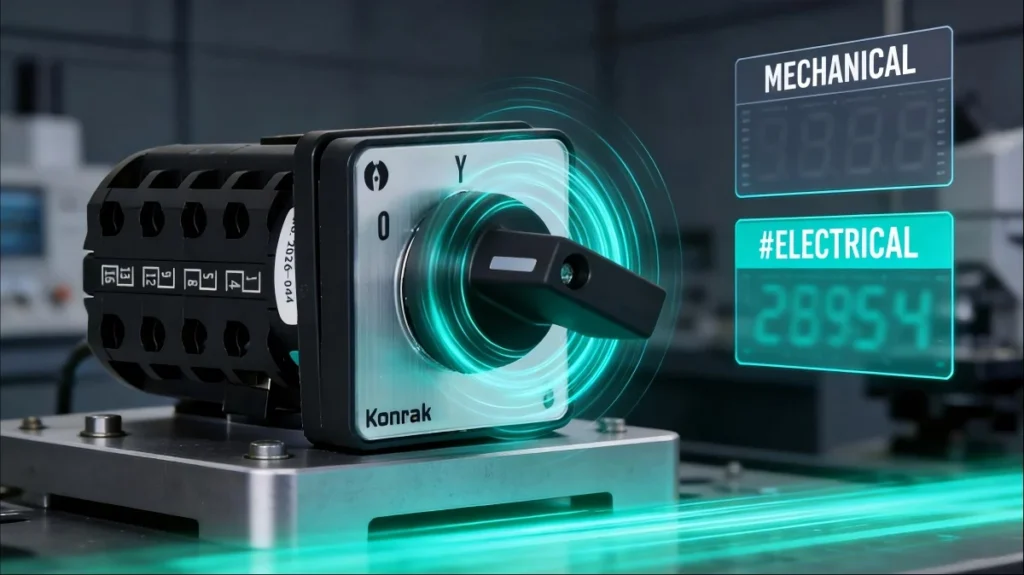
[IMAGE: 1 – lifespan comparison visual]
ALT text: “cam switch lifespan mechanical vs electrical life comparison”
Insert a visual contrasting the two life ratings.
What Shortens Life in Practice
- Higher utilization categories: AC-4 (inching/plugging) is far more severe than AC-21A.
- High switching frequency without cool-down time.
- Harsh environment: pollution degree 3 and dust accelerate contact and insulation degradation.
- Low-quality contact material — the reason premium switches use silver alloy.
Most premature failures are not a rating problem; they are a duty-matching problem. An AC-4 application with frequent inching wears contacts faster than any datasheet table suggests, because every inching cycle is a full make-break under locked-rotor current. Environment compounds the effect: dust and pollution raise contact resistance and speed up insulation aging.
The 1-Million-Operations Design Target
- Industry practice: cam switches are designed for up to 1 million mechanical operations.
- Note the wording: “designed for” — this is a design objective, not a certified endurance claim.
The 1-million figure appears in many catalogs, but it is a mechanical design target based on mechanism wear, not a test result. When a supplier quotes it, ask what standard and what test sequence produced the number. A transparent datasheet separates the design target from certified electrical-life results, and publishes both.
“Designed for 1 million operations” is a design objective, not a certified endurance claim.
Reading a Life Rating on a Datasheet
- A “mechanical life” figure without a load category tells you little; ask which standard and which test sequence produced it.
- Electrical life is always quoted per utilization category — the same switch that manages 6,000 loaded cycles in AC-4 duty will manage far more in AC-21A resistive duty.
- Ask for the breakdown of loaded versus unloaded cycles in the endurance test; a transparent supplier will state it (Konrak: 1,500 loaded + 8,500 unloaded in its 10,000-cycle test).
The same cam switch lifespan figure means nothing until it is attached to a duty. An AC-21A rating can look impressive next to an AC-4 rating from another brand — compare like with like, and always request the loaded/unloaded breakdown so you can judge how much of the test was actually done under current.
Konrak’s Test Evidence
- AC-23A / AC-22A: 10,000 operation cycles passed (1,500 loaded + 8,500 unloaded).
- AC-4: 6,000 loaded cycles passed.
- Operating force measured around 12N — light and consistent operation reduces mechanical wear.
- Temperature-rise margin (LW26-32 at 36–40K vs. 80K limit) keeps contacts cool, protecting electrical life.
The endurance results come from the same TÜV SÜD test program that covers the LW26 series against IEC 60947-3. A 12N operating force means the mechanism is consistent and light to turn, which reduces mechanical wear over hundreds of thousands of cycles. Combined with the temperature-rise margin, the data tell one story: the switch is designed to keep both its mechanical and its electrical life.
How to Extend Switch Life
- Select the utilization category honestly — don’t derate a motor load into a resistive category.
- Leave thermal margin in sizing.
- Keep the environment clean and within pollution degree 3 assumptions.
Honest duty selection is the single biggest lever. A motor load specified as AC-23A instead of AC-21A keeps the contacts inside their design envelope. Thermal margin comes next: a switch sized with headroom runs cooler, and every 10K of temperature reduction meaningfully extends contact life. The contact material matters too — see our guide to cam switch contact material for why silver alloy is the premium choice, and browse the LW26 rotary cam switch range for your duty.
Summary: The Lifespan Checklist
A confident cam switch lifespan decision comes down to three questions. Use this checklist when comparing suppliers:
- Ask for both mechanical and electrical life, each tied to a standard and a test sequence.
- Confirm the electrical-life figure matches your utilization category (AC-21A to AC-4).
- Check the loaded/unloaded cycle breakdown in the endurance test.
- Verify the operating force and temperature-rise margin that protect the mechanism and contacts.
Konrak will share its endurance test data with you — email davy@konrak.com or visit www.konrak.com.
Frequently Asked Questions
Is the 1-million-operation mechanical life a certified rating?
No. It is a design target for the mechanism, not a certified endurance claim. Always ask which standard and test sequence produced any life figure you are quoted.
Why is electrical life shorter under motor load?
Motor loads draw high inrush current and produce strong arcs at every break. In AC-4 duty (inching and plugging), every operation is a full make-break under locked-rotor current, so contacts erode far faster than in resistive AC-21A duty.
How do I compare lifespan figures between suppliers?
Compare like with like: the same utilization category, the same standard version, and the same loaded/unloaded test breakdown. A figure without these details is not comparable.